Five Senses and Food Choices
These activities raise awareness of the five senses and the role the senses play in making food choices. We read a book about the senses and practice using them in center activities.
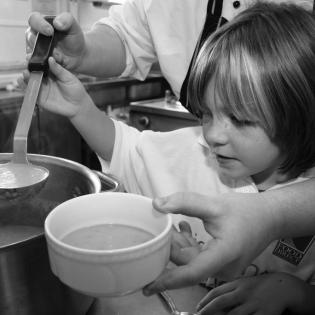
The learner will:
- state the names of the five senses and identify the purpose of each.
- foods of different sizes and textures
- volunteers at each center
- read-aloud copy of My Five Senses (See Bibliography)
To help prepare for this lesson, send out a request for parent helpers in advance. You will need at least one helper for each center. Parents can also purchase and prepare the foods for the centers.
- Aliki. My Five Senses. Harper Trophy, 1990. ISBN: 006445083X
- Nayer, Judy. My Five Senses: A Lion's Tale. Massachusetts: Newbridge Educational Publishing, 1994. ISBN: 1567840671. <www.newbridgeonline.com>
Instructions
Anticipatory Set:
Ask the children to close their eyes while you pass something under their noses (a cut lemon, chocolate candy, coffee beans, or peanut butter). Hide the item from sight as they open their eyes, and discuss what they think it was. Ask them to tell you what sense they used to figure that out. Ask them what other senses they have and how they could use those senses to observe the object in a different way. For example, they could use their sense of touch to feel the shape of the lemon. They could use their sense of hearing to observe how the coffee beans sound as they drop or shake in a cup.
Read aloud a book about our senses. Discuss how the five senses help them observe the world. Ask the children to reflect on what their five senses are and how they use them. Encourage several children to give their responses and ideas.
Put the children into five groups to rotate to five centers. Each center will focus on a single sense. There may be a variety of foods of different sizes, temperatures and textures (green banana/ripe banana, outside/inside of pepper, grape, apple, grapefruit, lettuce). The children will use one sense at a time to observe the foods and discuss and describe in detail. The volunteer records their observations in a journal to share later. The facilitator signals when the groups rotate, making sure they have enough time at each center.
Centers:
- Touch: Have the children handle foods with their eyes closed or blindfolded (no eating). After feeling all the choices, ask them to select one thing that they think they'd like to eat based on feel. Ask them to explain their choices. Write down their comments.
- Taste: Have them small samples of foods of different tastes (sweet, sour, bitter, and salty). As children sample the foods, write down their comments. Tally which foods children choose as their favorite flavors.
- Smell: Have children close their eyes and use only their sense of smell to make choices. After smelling all the choices, ask them to select one thing that they think they'd like to eat based on smell alone. Ask them to explain their choices. Write down their comments.
- Sight: Choose items that may not be familiar to students for this center. Have students use only their sense of sight to make choices. After looking at all the choices, ask them to select one thing that they think they'd like to eat based on sight alone. Ask them to explain their choices. Write down their comments.
- Hearing: Have students turn their back to the facilitator. Use foods that make noise (cold cereal, pouring milk, snapping carrots, breaking chips). Ask children to identify the foods.
Reflection:
As a whole group, talk about how our senses determine what food is interesting and desireable.
- Why do we have different food favorites?
- Is it important for food to look good and have a pleasant texture? Why or why not?
- Why do people in different countries eat different foods?
- When might it be important to eat something that we don't love or doesn't look attractive?
Philanthropy Framework
-
Strand PHIL.I Definitions of Philanthropy
-
Standard DP 02. Roles of Government, Business, and Philanthropy
-
Benchmark E.3 Identify ways that trust is important in all communities.
-
-
-
Strand PHIL.II Philanthropy and Civil Society
-
Standard PCS 01. Self, citizenship, and society
-
Benchmark E.1 Define the word <em>trust</em> and its role in all communities.
-
-
Standard PCS 02. Diverse Cultures
-
Benchmark E.4 Demonstrate listening skills.
-
-