Subjects:
Library / Technology, Philanthropy and Social Studies
Key Words/Concepts click to view
| Lesson 1 : | PHIL: | Need |
| | SOC: | Analyze/Interpret; Choices/Consequences; Great Depression; Primary/Secondary Sources |
| Lesson 2 : | PHIL: | Motivation for Giving; Time/Talent/Treasure |
| | SOC: | Hard Times; Analyze/Interpret; Four Economic Sectors; Good Character; Government; Great Depression; Interview; Personal Virtue; Primary/Secondary Sources |
| Lesson 3 : | PHIL: | Community/Social Capital; Foundations; Nonprofit Sector |
| | SOC: | Community Capital; Economic Systems; Four Economic Sectors; Good Character; Great Depression; New Deal; Personal Virtue; Public Policy |
Unit Overview:
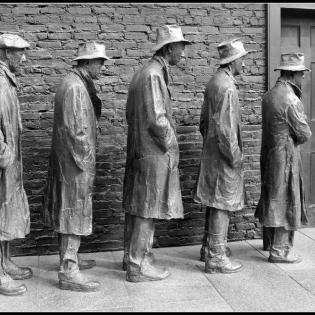
This unit was created to focus on economic issues during the Depression years, while also bringing an awareness to the students about how difficult life was for individuals living during the period. The unit also makes a connection with solutions to the depression, and the role that philanthropy played in those solutions. Students experience life during the depression by interpreting primary source pictures, reading oral histories from Studs Terkel’s Hard Times, and discussing why the U.S. was able to successfully come out of the Depression. The unit makes the assumption that the teacher has already prepared students with information about how the depression occurred, and students are asked to deal with the ramifications.
Unit Purpose:
The purpose of the Surviving the Depression Unit is to force students to look at the ramifications of the depression in detail. Students will experience the occurrences through primary sources, while making a connection with the role that philanthropy played in bringing the country back to its original strength and building community capital.
Unit Objectives:
The learners will:
- interpret primary sources from the Great Depression.
- explain how philanthropy created community capital during the Great Depression.
- describe how the difficult economic conditions during the Great Depression changed American life.
- analyze Americans’ motivations for giving and sharing during the Great Depression.
- evaluate proposed solutions for the Great Depression.
- describe how the New Deal components affected all segments of society.
- evaluate the role of nonprofits during the New Deal.
Service Experience:
Although lessons in this unit contain service project examples, decisions about service plans and implementation should be made by students, as age appropriate.
Students will create a school display of national foundations, showing their present mission and projects.
Unit Assessment:
An essay question is included on a general Depression Test.
School/Home Connection:
- “Copy-and-Paste” Class/School Newsletter Information Insert:
Students will study the Great Depression, taking a closer look at the attempts of the four sectors of the economy (government, for profit businesses, non-profits, and the family) to help people during the time of severe economic deprivation. A special look at local efforts will be included.
- Interactive Parent / Student Homework:
Students are asked to discuss with family members their impression about the Great Depression and to discover, if possible, how their town tried to help its residents through such trying times. This is located in Lesson One: Life During the Depression—Pictures.
Notes for Teaching:
- In order to teach this unit, the teacher may opt to purchase materials that will aid in preparing this unit: Jackdaws photographs – Depression series.
Jackdaw Publications,
P.O. Box 503,
Amawalk, NY 10501.
1-800-789-0022; fax 1-800-962-9101
Website: www.jackdaw.com
An option is to use the Great Depression photos on the Web site of the Library of Congress.
- Terkel, Studs. Hard Times: An Oral History of the Depression. New York: Pantheon Books, 1986. This book is available in libraries as a general reference on the Great Depression.
- Where journal entries are mentioned, please note that the journals are used as a beginning of all the lessons in order to focus student attention immediately upon the issue to be discussed in the classroom for the day. Journal entries are usually expected to be three to four sentences long.
State Curriculum and Philanthropy Theme Frameworks:
See individual lessons for benchmark detail.
Lessons Developed and Piloted By:
Gita Gemuts
Jackson Public Schools
Jackson High School
544 Wildwood Ave
Jackson, MI 49201