Learning to Give, Curriculum Division of The LEAGUE

The LEAGUE

Life During the Depression—Pictures
Lesson 1:
printEmail this Lesson
Lesson
Handouts
Academic Standards
Philanthropy Framework

Purpose:

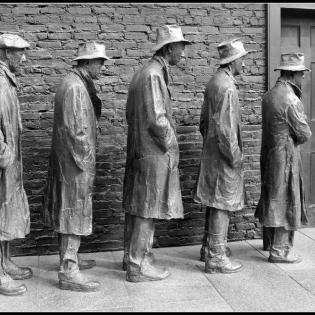
Students will be introduced to life during the Great Depression by looking at primary source pictures taken during the 1930s.

Duration:

One to Two Fifty-Five Minute Class Periods

Objectives:

The learner will:
  • interpret primary sources from the Great Depression.

  • hypothesize about possible solutions that could have relieved suffering during the Great Depression.

Materials:

  • Jackdaw’s photographs – Depression series. (See Bibliographical References for ordering information or go to the Web site for the Library of Congress and download pictures of the depression.)
  • Depression Pictures (Attachment One)
  • Problems/Solutions Chart (Attachment Two)
  • Group Grading Rubric (Attachment Three)
Handout 1
Depression Pictures
Handout 2
Problems/Solutions Chart
Handout 3
Group Grading Rubric

Instructional Procedure(s):

Anticipatory Set:
Begin class with the following journal entry: “Describe how you think individuals lived during the Great Depression.” After students have completed their journal entries, ask a few students to share what they have written. End the sharing by thanking the students and stating that today will begin the process of learning more about how individuals lived during the Great Depression.

  • Divide the students into groups of three. Have students assign the following jobs to each member in the group: facilitator, recorder and narrator. Describe the jobs of each person. The Group Grading Rubric (Attachment Three) can also be shared with students here, if students have never worked in cooperative learning groups before.

    • Facilitator – leads and keeps the group on track.

    • Recorder – writes down what the group discusses while answering the handout questions.

    • Narrator – shares the group’s answers with the rest of the class.

  • Give each group one copy of Depression Pictures (Attachment One). Give each cooperative group a picture for study. Remind students to answer their questions thoughtfully and with care and explain that they will have twenty minutes to accomplish the task. At the end of the time limit, check to see that everyone is ready. If a majority of the groups still need more time, allow an extra five minutes.

  • Ask for a group to volunteer to begin discussing their picture. If there are no volunteers simply choose a group. Invite the entire group to the front of the room, and have them tape their picture on the board. Ask the narrator to give a short synopsis about their answers to the handout questions. Once the narrator has completed the task, ask the rest of the class to make comments on the picture, and ask them to add any solutions to the problem they see in the picture. While students are describing solutions, the teacher should write the problem and solutions offered on to an overhead transparency copy of Problems/Solutions Chart (Attachment Two) to be used later.

  • Once the students have all presented their pictures to the class, the teacher should show the completed overhead. Allow the class to discuss their solutions.

  • Ask the class to look at the solutions and see if they can create some categories for the solutions, e.g., governmental, philanthropic, individuals, civic, etc. End the discussion by saying that the overhead created today is an example of what the students will be expected to do tomorrow when working on their next assignment, and the groupings that they have created will also be used.

  • In preparation for tomorrow’s lesson the teacher should create cards that can be posted which list each of the categories designated by the students.

Assessment:

The evaluation of group work may be used as the assessment for this lesson.

School/Home Connection:

Interactive Parent / Student Homework:
Ask students to ask their parents, grandparents or other relatives to share what they know about the Great Depression, whether they actually experienced it or just heard about it. Of particular interest may be the question about what their locality did to make life easier for its residents who were going through hard times.

Extension:

Use more pictures for future journal entries and continue to have students actively interpret them for the duration of the unit.

Bibliographical References:


Lesson Developed and Piloted by:

Gita Gemuts
Jackson Public Schools
Jackson High School
Jackson, MI 49201

Handouts:

Handout 1Print Handout 1

Depression Pictures

Facilitator:________________ Recorder:___________________ Narrator:_________________

The Recorder should write down the group’s answers to the following questions.

  1. Briefly describe your picture.


  2. How do you feel when you look at the picture?


  3. Look at the faces of the individuals in the picture. What do you think the person is feeling and why?


  4. What does your picture show us about life during the Great Depression?


  5. Describe some solutions that could help the people/person in your picture.


Handout 2Print Handout 2

Problems/Solutions Chart

Problems
Solutions


Handout 3Print Handout 3

Group Grading Rubric

4 - All 4 items checked 3 - 3 items checked 2 - 2 items checked
1 - 1 item checked 0 - No items checked  

Evaluate each item individually, and at the end of the score sheet, follow the formula to receive your final grade.

Facilitator:  
___ Involved all group members in the discussion
___ Kept the group on task
___ Asked questions to keep the discussion going
___ Was polite to all group members
Score A: ________
Recorder:  
___ Wrote down as many comments from discussions as possible
___ Communicated the final answers to the group once written down
___ Participated in discussion
___ Was polite to all group members
Score B: _________
Narrator Score C: ________
___ Participated in discussion
___ Was polite to all group members
___ Prepared with group to discuss what would be presented
___ Presented efficiently and well
 
Group: Score D: ________
___ Group worked quietly, not disturbing anyone else
___ Group worked efficiently, completing the task
___ Group answers were thoughtful and well discussed
___ Group worked well together
 
Grade: Score A: ________ + Score B: ________ + Score C: ________ + Score D: ________
Total: ___________ divided by 4 = ________


4.0 = A 3.9 - 3.7 = A- 3.6 - 3.4 = B+ 3.3 - 3.1 = B
3.0 - 2.8 = B- 2.7 - 2.5 = C+ 2.4 - 2.2 = C 2.1 - 1.9 = C-
1.8-1.6 = D+ 1.5 - 1.3 = D 1.2 - 1.0 = D- .9 - 0 = E

Philanthropy Framework:

Submit a Comment

Unit Contents:

Overview:Surviving the Depression—1930-1939 Summary

Lessons:

1.
Life During the Depression—Pictures
2.
Life During the Depression—Stories
3.
Solutions to the Depression

All rights reserved. Permission is granted to freely use this information for nonprofit (noncommercial), educational purposes only. Copyright must be acknowledged on all copies.

Copyright © LearningToGive.org