Learning to Give, Philanthropy education resources that teach giving and civic engagement

generationOn

Find Lesson Plans Browse Resources
Look at Philanthropy in Children's Literature (A)
Lesson 1:
printEmail this Lesson
Lesson
Handouts
Academic Standards
Philanthropy Framework

Purpose:

To introduce students to the idea of helping others and to have them understand that they can also be philanthropic. (They have time, treasures and/or talents to share.)

Duration:

One-three Forty-Five Minute Class Periods with several 10-15 minute read-aloud sessions prior to this lesson

Objectives:

The learners will:
  • listen to a collection of stories about philanthropic acts.

  • brainstorm, within groups, a list of community needs and service projects that could be performed by their own class

Materials:

  • Several books that have a philanthropic theme. (see Bibliographic References)

  • Chart paper

  • Markers, pencils

  • Computer with Internet link (Optional)
Handout 1
How Have They Helped?
Handout 2
Home Letter

Instructional Procedure(s):

Anticipatory Set:(This is an unusual anticipatory set in that it will last over the period of several days)

The teacher will:

  • Over the period of several days, introduce and read several books that have a philanthropic theme using the sample below:

  • Write the word ‘philanthropy’ on the board.

  • Ask the students if they remember what this word means (if they have had previous lessons), or ask them if they know what it means.

  • Review (explain) that philanthropy is the giving of ones time, treasures and talents for the common good (the good of everyone).

  • Remind the students that the common good is a Core Democratic Value, which means that it is our right as a citizen of this country to do things for the good of everyone.

  • Introduce the story for the day:

  • Legend of Freedom Hill, The by Linda Jacobs Altman is the story of two girls, one black, and the other Jewish, who buy the black girl’s mother’s freedom with gold that they had mined. They give up their claim to the mine so that other slaves could also go free.

  • Wanda’s Roses by Pat Brisson is a story about a girl who works with the people in her community to create a beautiful rose garden.

  • Miss Rumphius by Barbara Cooney is the story of a woman who wants to fulfill her dream of doing something to make the world more beautiful, so she plants flower seeds across the country.

  • Johnny Appleseed by Patricia Demuth is the story of a man who travels across the country planting apple trees for others to enjoy.

  • City Green Dyanne DiSalvo-Ryan.

  • Uncle Willie and the Soup Kitchen by Dyanne DiSalvo-Ryan.

  • The Can-Do Thanksgiving by Marion Hess Pomeranc.

  • Something Beautiful Wyeth, Sharon Dennis.

    After each reading of the individual books, have students discuss in groups how each character in each book has contributed something philanthropic to his/her community. Then call individuals to report for their group. The teacher will record their responses onto a chart (See Attachment One: How Have They Helped?).

  • Review with students the general theme of the books that were read throughout the previous week. (Giving of ones times, talents and treasures for the common good) Review the chart (See Attachment One: How Have They Helped?).

  • Ask students if they think there are any philanthropic acts that they feel they would be able to do. Hopefully, students will respond positively, if not, give them suggestions of things they already do that are philanthropic. Example: pick up trash on the playground, offer to clean up an area of the classroom during recess, play with a new student, etc.

  • Tell the students that you have another book that you’d like to read to them that gives suggestions for things younger people can do to help their community. Read aloud Helping Out is Cool by Ellen Feinman Moss.

  • Tell the students that they are going to work together to discover needs in their school or community and choose a service project for their class.

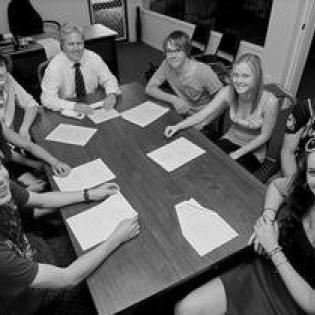
  • Assign students to a group of 4. Give them chart paper and markers with which to brainstorm a list of school or community needs and service projects that the class could perform to address the need. This could take more than one day if you wish to allow students to do the research on web sites. To save time, the teacher may wish to download the information prior to this lesson. (See bibliography.)

  • Ask each group to report their results.

  • Tell the students that during the next lesson they will select at least one project for the class to complete.

Assessment:

Through observation, the teacher will determine the students’ understanding of needs and possible service projects that would be appropriate for the class to perform.

School/Home Connection:

Interactive Parent / Student Homework:
See Lesson One: Attachment Two: Home Letter

Bibliographical References:

  • Altman, Linda Jacobs. The Legend of Freedom Hill, New York: Lee & Low Books Inc., 2000. ISBN 58430-003-5.

     
  • Brisson, Pat. Wanda’s Roses, Honesdale: Boyds Mills Press, 1994. ISBN 1-56397-925-X. Cooney, Barbara. Miss Rumphius, Viking Press, 1985. ISBN 0140505393.

     
  • Demuth, Patricia. Johnny Appleseed, Aladdin Paperbacks, 1996. ISBN 0671667467.

     
  • DiSalvo-Ryan, Dyanne. City Green, New York, Morrow Junior Books, 1998. ISBN 0-688-12786-X.

     
  • DiSalvo-Ryan, Dyanne. Uncle Willie and the Soup Kitchen, First Mulberry Edition, 1997. ISBN 0-688-15285-6.

     
  • Lewis, Barbara A., Kid’s Guide To Service Projects, The, Minneapolis: Free Spirits Publishing, 1995. ISBN 0-915793-82-2. www.freespirit.com.

     
  • Lewis, Barbara A., Kid’s Guide To Social Action, The, Minneapolis: Free Spirits Publishing, 1995. ISBN

     
  • Moss, Ellen Feinman. Helping Out Is Cool, Downsview: Tumbleweed Press, 1997. ISBN 0-9680678-5-9.

     
  • Pomeranc, Marion Hess. Can-Do Thanksgiving, The, Morton Grove: Albert Whitman and Co., 1998. ISBN 0-8075-1054-8

     
  • Schwartz, Linda. How Can You Help?, Santa Barbara: The Learning Works, Inc. 1999. ISBN 0-88160-213-2.

     
  • Wyeth, Sharon Dennis. Something Beautiful. New York: Bantam Doubleday Dell Publishing Group, Inc. 1998. ISBN 0-385-32239-9.

     
  • Learning to Give Home Page <http://learningtogive.org>
     

Lesson Developed By:

Mary Petro
Albion Public Schools
Harrington Elementary
Albion, Michigan

Handouts:

Handout 1Print Handout 1

How Have They Helped?

Title Example of Philanthropy Characters Who Helped Who Was Helped?


Handout 2Print Handout 2

Home Letter

Dear Families,

During the past week I have read several stories to the students about people who helped to improve their community. In our Social Studies/Learning To Give lesson today we discussed possible service projects that our class might be able to perform. I have asked the students to do more research with their parents. Would you please share with your child any service projects that you have been involved in or projects that you’ve heard of that may be ones in which our students can be involved? There are many web sites that provide several suggestions. The Learning To Give service-learning toolkits http://learningtogive.org/genonltg/servicetoolkits/ provide examples of service projects for youth. We will share these suggestions with the class during tomorrow’s lesson. Thank you in advance for your assistance.
Sincerely,
 

Philanthropy Framework:

Submit a Comment

All rights reserved. Permission is granted to freely use this information for nonprofit (noncommercial), educational purposes only. Copyright must be acknowledged on all copies.

Generated by Points of Light International
Follow generationOn on Facebook
Message