Sojourner Truth, 19th Century Activist
Sojourner Truth's contributions to abolitionism and women's suffrage are revealed through her own words. She worked tirelessly to aid the freed men after the Civil War and brought increased recognition to their plight. We discuss the right of all voices to be heard in a democracy and determine how Sojourner Truth's work was philanthropic.
- Recognize that Sojourner Truth is a philanthropist whose voice and actions impacted society.
- Identify the intersectionality of the women's movement and anti-slavery.
- copies of handout "Ain't I A Woman?"
- copies of handout "Sojourner Truth"
- "The Sojourner Truth Project" shows a comparison between two versions of the famous speech - https://www.thesojournertruthproject.com/
All history is recorded from a perspective. How can we be sure today to pass on the most accurate accounts? Why is it best (for the common good) to advocate for a cause from carefully researched facts rather than passing on (even the best intentioned) opinions?
- The Narrative of Sojourner Truth (1850) dictated by Sojourner Truth (ca.1797-1883), edited by Olive Gilbert - http://digital.library.upenn.edu/women/truth/1850/1850.html
- The Sojourner Truth Prohject - https://www.thesojournertruthproject.com/
- Suffrage and Civil Rights - https://www.docsteach.org/activities/teacher/the-suffrage-and-the-civil-rights-reform-movements
Instructions
Anticipatory Set:
Read the first paragraph of the speech, "Ain't I A Woman?" (see handout below). Show a YouTube version of someone reading this or read the rest of the speech in turns.
Draw a circle on the board and label it "Sojourner Truth." Draw four lines out from the circle. Based on the reading, ask the learners to supply descriptive words to write around the circle. They may start to fill in categories of what they know and want to know in the graphic organizer.
Using Sojourner Truth (handout) as a reference, introduce Sojourner Truth, her life, and the causes she supported. Continue to fill in the graphic organizer as a group.
Define intersectionality as the overlapping systems of discrimination one faces by having more than one social characteristic. For example, the attributes of being black and a woman compound the discrimination faced by either group. Different aspects of one's social and political identities may bring privilege or discrimination.
Define philanthropy as giving time, talent, or treasure for the common good. While often narrowly defined as giving money, philanthropy may include activism, volunteering, and using one's voice to make change. Explain that Sojourner Truth's contributions are a form of philanthropy (providing time, talent, and/or treasures for the common good). Identify in what ways Sojourner Truth's work was giving for the common good.
The women's movement worked in collaboration with the antislavery movement in this country. Ask learners to think about this and write some ideas about what they think are the benefits and challenges of combining the efforts.
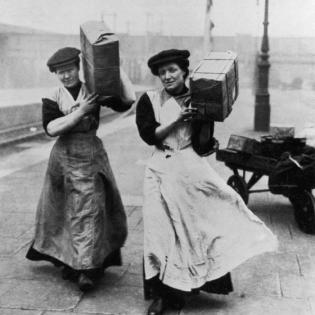
This article gives some specifics around an archival photo.
Handouts

Philanthropy Framework
-
Strand PHIL.I Definitions of Philanthropy
-
Standard DP 01. Define Philanthropy
-
Benchmark MS.1 Define philanthropy as individuals and organizations providing their time, talent, and/or treasures intended for the common good throughout history and around the world. Give examples.
-
-
-
Strand PHIL.II Philanthropy and Civil Society
-
Standard PCS 02. Diverse Cultures
-
Benchmark MS.2 Describe the importance of hearing all voices in a community and respecting their right to be heard.
-
Benchmark MS.5 Discuss examples of groups denied their rights in history.
-
Benchmark MS.7 Identify women and minorities who are or have been leaders in the civil society sector.
-
-
Standard PCS 06. Philanthropy in History
-
Benchmark MS.5 Identify positive philanthropic historic acts or events that helped build the community, state, and nation.
-
-
-
Strand PHIL.III Philanthropy and the Individual
-
Standard PI 01. Reasons for Individual Philanthropy
-
Benchmark MS.4 Identify and describe the actions of how citizens act for the common good.
-
-