Elizabeth Cady Stanton, Suffragist
We learn about Elizabeth Cady Stanton and her leadership of the woman's suffrage movement. At the time it was hard for some people to see that women deserved equality or that change was possible, but her persistence and organization techniques helped raise awareness and involvement.
- Compare the Declaration of Sentiments to the Declaration of Independence.
- Describe the context of the women's rights movement.
- copies of Notes on Elizabeth Cady Stanton (handout)
- copies of Declaration of Sentiments (handout)
- access to the text of the Declaration of Independence (found online and in American history textbooks)
- Barnes, Paul and Ken Burns (Producers). The Story of Elizabeth Cady Stanton and Susan B. Anthony: Not For Ourselves Alone. http://www.pbs.org/kenburns/not-for-ourselves-alone
- The Susan B. Anthony Center for Women's Leadership
Instructions
Anticipatory Set:
In a 3-minute video clip called 'Women's Suffrage' from the Ken Burns movie Not For Ourselves Alone, a woman said, "In those days women were in the home. Men did the voting. And they let them do the voting; they weren't interested. There was a woman who educated people on why women should have the vote. That impressed me very much. They were a little bit unladylike, but when we got the vote, we were thankful to them. But we had to wake up too."
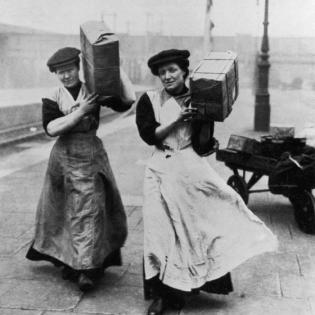
Recall how the conditions were in the Industrial Revolution for women. Recount the 14-16 hour workdays, the low pay, and the additional work expected of them when they arrived home. At this time, women did not lawfully have equal rights to men. Define Suffragette.
The issues may not be the same today, but we still have ideas about groups of people that aren't true. Some people associate young black men with crime or old people with backwards ideas. In the 19th Century, people believed women had no right to vote.
Discuss the concept of being open to new ideas. Sometimes we don't know things can be better. Sometimes we don't see things that are not fair. Discuss what could keep us from seeing things the way they are, like women did before suffrage?
Meet in groups to read the handout Notes on Elizabeth Cady Stanton.
Distribute copies of Declaration of Sentiments (handout). Read aloud the first couple sentences and ask why the language sounds familiar.
- At that time, the words of the Declaration of Independence were very familiar, so adding "women" to the text would have been shocking, even to women. Look at the words of the Declaration of Independence and see the similarities.
Discuss why she would have modeled her document on the Declaration of Independence.
- The words of this respected document would make it possible to have the voices of women listened to with more interest.
To quickly get a sense of the document, have pairs read solution sections and summarize their part for the rest of the group.
Discuss the resolutions and what impact they would have on women's lives and on the country as a whole.
At the Seneca Women's Conference, all resolutions were passed, even supported by the men who were present.
Elizabeth Cady Stanton was an activist and philanthropist who gave her time and talent related to her passion to make the world better and to help others. All of the big movements and major changes in history were started by people who identified a need or problem in society and sought a solution through their voice, time, and talent. We can take part in change today in the same way.

Philanthropy Framework
-
Strand PHIL.I Definitions of Philanthropy
-
Standard DP 01. Define Philanthropy
-
Benchmark MS.1 Define philanthropy as individuals and organizations providing their time, talent, and/or treasures intended for the common good throughout history and around the world. Give examples.
-
Benchmark MS.4 Give examples of how individuals have helped others.
-
-
-
Strand PHIL.II Philanthropy and Civil Society
-
Standard PCS 02. Diverse Cultures
-
Benchmark MS.2 Describe the importance of hearing all voices in a community and respecting their right to be heard.
-
Benchmark MS.5 Discuss examples of groups denied their rights in history.
-
-
Standard PCS 06. Philanthropy in History
-
Benchmark MS.5 Identify positive philanthropic historic acts or events that helped build the community, state, and nation.
-
-
-
Strand PHIL.III Philanthropy and the Individual
-
Standard PI 01. Reasons for Individual Philanthropy
-
Benchmark MS.4 Identify and describe the actions of how citizens act for the common good.
-
-