The learner will:
recognize Africa on the map and identify it as a continent.
state the origin of Kwanzaa.
describe the general characteristics of Kwanzaa.
construct a kinara, or candle holder, to be used in the following lessons.
interpret vocabulary through music and movement.
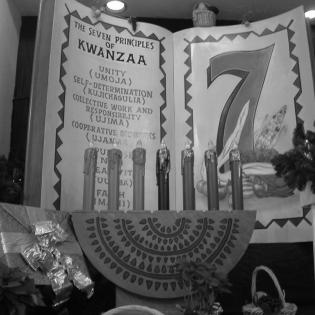
identify the seven principles of Kwanzaa.
relate each principle to something familiar or apply to his or her own life.
demonstrate understanding of each principle through dance, art, drama or chant.
Starting on Day One of Lesson Three: Habari Gani: The Last Four Principles, students choose to help a local food bank or organization that feeds the poor in the community. The students make a plan for helping and carry out their plan.
Display the seven principles of Kwanzaa along with explanations and examples on a school bulletin board. The goal of the bulletin board would be to encourage the other school community members to apply the principles.
Hold a Karamu feast and invite another class, parents or senior citizens. At the feast, students will demonstrate their projects and music, and teach what they have learned.
Students will fill in the information that was learned on the “What We Learned” chart (See Lesson One: What Is Kwanzaa?, Attachment Two: What We Learned.) They may use pictures, symbols or temporary spelling to complete their individual charts. Add to the class chart started in Lesson One. They may add to the chart every day as they learn the principles or at the end of the unit as a review.
“Copy-and-Paste” Class/School Newsletter Information Insert:
We are beginning a unit about Kwanzaa, an African American holiday. This unit teaches students about the principles featured daily in the important holiday that seeks to bring unity and pride to the African American community. The principles of Kwanzaa are connected to universal principles for life within any community. As the students learn about each principle, they demonstrate their understanding through the arts. Students are challenged to apply the principles to their everyday lives in a way that enhances the communities to which they belong. If parents have any traditional Kwanzaa art, costumes and foods they would like to share, this will enrich our study.
Interactive Parent / Student Homework:
Students talk with their families about the principles learned from the seven days of Kwanzaa. (See Lessons Two: Habari Gani (What Is the News?) and Three: Habari Gani: The Last Four Principles, Attachment One: Kwanzaa Principles.)
See individual lessons for benchmark detail.
Lessons Developed and Piloted By:
Anita Burton
Benton Harbor Area Schools
Creative Arts Academy
885 N. Shore Drive
Benton Harbor, MI 49022
All rights reserved. Permission is granted to freely use this information for nonprofit (noncommercial), educational purposes only. Copyright must be acknowledged on all copies.