Learning to Give, Curriculum Division of The LEAGUE

The LEAGUE

Growing Our Future
Unit of 4 lessons
printEmail this Unit Overview

Unit Overview:

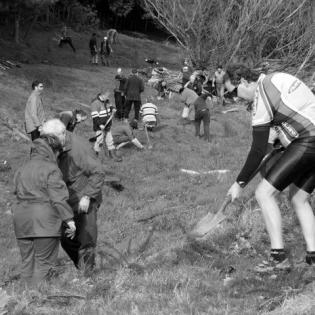
Learners will take part in a service learning project involving trees.  They will discuss the meaning of philanthropy and come to a consensus as to how they can help improve the community with trees.  Through the use of literature, video, music, and drama, they will reflect what they can do to make a difference in their community.  They will carry out a service project of planting trees in a common area.  By using waste paper from the school, learners will participate in the process of recycling to help take care of the trees using the natural process of composting.

Unit Purpose:

The learners will understand the importance of giving their time, talent, and treasure to promote our natural resource of trees.  They will participate in a service learning project involving planting new trees and recycling waste paper to make mulch.  The learners will express their understanding and accomplishments in a variety of ways.

How can a learner use his/her time, talent, and treasure to renew our natural resource of trees?

Can a young person truly make a difference in our world?

Unit Objectives:

The learner will:

  • identify the main idea of The Lorax and act out the story while the teacher reads it aloud. 
  • recognize that we have a responsibility for the common good and can be good stewards of trees.
  • define and give examples of selfishness and selflessness. 
  • brainstorm the uses of trees and sort into meaningful categories. 
  • define the four sectors of society--family, business, government, and non-profit--and discuss each sector's interest in trees. 
  • compare and contrast private property and common resources.
  • name some common areas where they could plant trees.
  • illustrate and identify the needs of a tree: water, food, and air.
  • follow directions to plant a tree in a pot.
  • discuss the benefits of nature.
  • give examples of actions students can take to improve the common good and list or describe responsibilities that go with these actions.
  • make a map of the area of where the trees are going to be planted.
  • plant the trees in a common area.
  • illustrate and reflect in writing on the planted trees.
  • write thank-you notes for the opportunity to plant in the common area.
  • develop a service plan to recycle paper from their school.
  • chart and graph the weight of shredded paper.
  • interpret the data from a graph.
  • demonstrate how to be a philanthropist by making a common area more beautiful.
  • write a letter to the nursery that helped to create the compost.

Service Experience:

Although lessons in this unit contain service project examples, decisions about service plans and implementation should be made by students, as age appropriate.

In Lesson 3: A Planting We Will Go, the learners will give their time, talent, and treasure by transplanting trees in a common area.

In Lesson 4: A-Shredding We Will Go, Students manage a school paper recycling project.  They shred the paper to be made into compost.  The compost is used to nourish the trees planted in Lesson Three.

Unit Assessment:

Assessment takes place through observation of student participation in discussions and activities. Several drawing and writing assignments are assessed for content.

School/Home Connection:

  • "Cut-and-Paste" Class/School Newsletter Information Insert
    Learners will take part in a service learning project involving trees.  They will discuss the meaning of philanthropy and come to a consensus as to how they can help improve the community with trees.  Through the use of literature, video, music, and drama, they will reflect what they can do to make a difference in their community.  They will carry out a service project involving planting trees in a common area, recycling paper, and using compost to take care of trees for the common good.
  • Interactive Parent/Student Homework
    Parent volunteers will be needed for Lessons Two and Three to help plant the trees.  Families are encouraged to visit the trees in the common area and observe their growth over the years.

Notes for Teaching:

This unit will require many weeks to complete.  Be sure to read all lessons before beginning. Before beginning this unit, contact a guest speaker to talk to the class about trees in Day Three of Lesson One.  This person may come from a local nursery, garden club, extension agency, Hoosier Releaf,  or parent gardener.  The speaker should present information about different types of trees, their benefits, their needs, and how students can be good stewards for the trees.

The re-enactment of The Lorax in Lesson One can be as elaborate or simple as the instructor desires.

For Lesson Two, make sure you have a classroom supply of bare-root trees to pot. These may need to be ordered several months in advance.  Free trees and plants service and Information can be found at http://www.freetreesandplants.com

Before beginning Lesson Three, potted trees must have grown an appropriate amount for planting outdoors.  Also, different trees have different planting times.  Be careful to plant the trees at the appropriate time of year.

In Lesson Three, you need permission to plant trees in a common area of the community. On Day Three of Lesson Three, you will need parent helpers and parent permission to go on a field trip to the common area.

Before beginning Lesson Four, check with your administration for placement of collection containers and for making a public announcement over the school's public address system. Make arrangements with a nursery for adding shredded paper to their compost pile and for a field trip to observe the compost pile. The time component for Lesson Four will be determined by the amount of paper collected and the time required for the paper to decompose. 

State Curriculum and Philanthropy Theme Frameworks:

See individual lessons for benchmark detail.

Lessons Developed and Piloted By:

Jill Finn
Indiana Summer Institute Writer
Indiana Summer Institute 2006
Indiana University Purdue University Indianapolis
Indianapolis, Indiana

Karin Huttsell
Indiana Summer Institute Writer
Indiana Summer Institute 2006
Indiana University Purdue University Indianapolis
Indianapolis, Indiana

Maggie Dean
Indiana Summer Institute Writer
Indiana Summer Institute 2006
Indiana University Purdue University Indianapolis
Indianapolis, Indiana

Submit a Comment

All rights reserved. Permission is granted to freely use this information for nonprofit (noncommercial), educational purposes only. Copyright must be acknowledged on all copies.

Copyright © LearningToGive.org