Limits of Power
Even the person viewed as the most powerful person in the world does not have unlimited power. Constitutionally, the president of the United States is limited by the "advise and consent" rule (and other checks and balances). The learners look at the importance of limiting government and identify how the common good benefits when citizens and students participate in their communities.
The learners will:
- describe the importance of placing limits on government.
- identify how an active citizenry benefits the common good.
- define philanthropy and describe how citizens and students can be philanthropic by taking an active role in the community and the school.
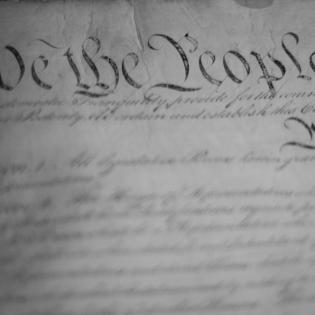
- access to the text of the Constitution of the United States found online
- Interactive Homework (handout)
- advice (n): recommendation regarding a decision or course of conduct
- advise (v): to give advice or counsel
- consent (v): to give approval or permission
- advice and consent: a requirement in the Constitution that limits presidential power to make treaties and appoint high-ranking government positions
Ask a parent or relative to describe an important decision they made in which others gave advice. Reflect on the advantages and disadvantages of asking for or receiving advice in this circumstance (see Attachment One).
Instructions
Anticipatory Set:
Brainstorm some important people and the types of things they make decisions about and act on. Ask who or what puts limits on the power these individuals have. Many people consider the president of the United States to be the most important person in the world, and even they have limits on what they are allowed to do.
Put the words advice and advise on the board and define the terms:
- advice (n) recommendation regarding a decision or course of conduct
- advise (v) to give advice or counsel
The president has some powers that he may only execute with the “advice and consent” of the Senate.
Refer to Article II, Section 2 of the Constitution which defines presidential powers. Point out when the president must act with the advice of the United States Senate (to make treaties; appoint ambassadors, other public ministers and consuls, and judges of the Supreme Court; name heads of executive departments). An example of how this works is the following: If a judge in a federal (U.S.) district court retires or dies, the president has the power to appoint his or her successor. Usually the two Senators from that state will make recommendations or advise the president on who should be appointed. The president may or may not take their advice. Once the president appoints someone to the position, it is up to the Senate to give consent, or approve, the appointment. If the Senate rejects the president’s nominee, a new person must be appointed. This is an example of checks and balances, which occur in all three branches of the government.
Explain that this model of not allowing the president to have all the decision-making power is used in other forms of “governing” as well. Ask the participants to think of examples, guiding them with the following questions:
- At home, is there an opportunity for household members to offer advice before a decision is made?
- In the school, does the principal have the power to make all decisions, or is the principal “advised” by others such as central staff, teachers, students and parents?
- Considering a classroom, are all decisions made by the teacher or is “advice” given by the students on some decisions?
Brainstorm and list the advantages and disadvantages of having decisions made with input from others.
State that one of the advantages in limiting power is that it protects us from having a government run by a dictator. The rights of all citizens are protected by limiting presidential power, which contributes to the common good. The common good benefits in many situations from considering diverse points of view. Discuss other protections that contribute to the common good (freedom of speech, freedom of assembly, putting the rule of law over the wishes of one person, equality, the right to vote).
Talk about how important it is for citizens to actively participate in their community and government.
In an open, democratic community, citizens will pay attention to issues and needs and contribute their time and talents for the common good. In a closed, totalitarian community, citizens will not be as free to act for the sake of the common good. In some circumstances, they may be told what to do, or they may leave problems to the government to be solved.
Pair off participants and give them three minutes to develop a list of ways citizens can participate in their government. Once time has elapsed, give an additional three minutes for them to describe how they can participate in their community to promote the common good.
Share lists.
Put the word philanthropy on the board. Ask for definitions. Define philanthropy as individuals and organizations providing their time, talent, and/or treasures and taking action for the common good. Brainstorm a list of such activities (include some examples in history and around the world as well). Going back to the previous lists accumulated in the three minute time segments, explain that citizens participating in their government and students participating in their community (school) are also examples of philanthropy since they are giving of their time and talent (and possibly treasures) for the common good of the whole community.
Let the learners discuss whether or not they have a responsibility to work to improve the common good in their community.
In journals, have participants reflect on what they have learned by answering the question, “What are the advantages to a community when decision making is shared (not made by one all-powerful leader)? ”
This lesson represents the investigation stage of the service-learning process.
Handouts

Philanthropy Framework
-
Strand PHIL.I Definitions of Philanthropy
-
Standard DP 01. Define Philanthropy
-
Benchmark MS.1 Define philanthropy as individuals and organizations providing their time, talent, and/or treasures intended for the common good throughout history and around the world. Give examples.
-
-
-
Strand PHIL.II Philanthropy and Civil Society
-
Standard PCS 05. Philanthropy and Government
-
Benchmark MS.7 Compare an open, democratic community to a closed, totalitarian community.
-
-
-
Strand PHIL.III Philanthropy and the Individual
-
Standard PI 01. Reasons for Individual Philanthropy
-
Benchmark MS.4 Identify and describe the actions of how citizens act for the common good.
-
Benchmark MS.5 Describe the responsibility students have to act in the civil society sector to improve the common good.
-
-