Learning to Give, Curriculum Division of The LEAGUE

The LEAGUE

This Land Is Our Land (Stewardship) (Private-Religious)
Unit of 3 lessons
printEmail this Unit Overview

Unit Overview:

Using traditional Jewish texts as a basis, students will learn about the importance of taking care of the environment and connect it with the fact that G-d created the world and now it is our responsibility to protect it. Through three different lessons the students receive a solid foundation and understanding that there are simple things we can do each day to preserve the environment and not to waste the good things that we do have. The students (while quite young) will have the opportunity to participate in activities that improve the outdoor, school, and home environments.  Students will also transfer the lessons they learned in the classroom to the entire school. There will be a link between classroom lessons, actions, and experiences to emphasize the importance of the taking care of the environment as G-d’s creation.

Unit Purpose:

This unit teaches young students a sense of responsibility to take care of the environment that G-d created. It also demonstrates that even young students have the power to contribute to the community.  One main piece of this is the importance of recycling.  Students not only learn about the environment and creation, but also perform acts that preserve the environment.

Focus Questions:

What is the connection between creation and taking care of the environment?
Why is it important to take care of the environment?
What is my role in caring for the environment?

Unit Objectives:

The learner will:

  • manipulate creation cutouts to show that G-d created the world step-by-step.
  • state that G-d placed people in charge of caring for nature.
  • give examples of ways people can take care of the environment.
  • grow plants and take care of them.
  • explain how Joseph, in Joseph Had a Little Overcoat, didn’t let his clothing go to waste.
  • recognize the benefits to the environment by repairing, reusing, and recycling rather than throwing things away.
  • demonstrate creativity in reusing old objects by turning them into new objects.
  • help with a large task by sharing responsibilities with others.
  • state ways to take care of the environment.
  • recognize that when everyone participates a little, we can share the job of taking care of the environment.
  • participate in a class project to improve the environment.

Service Experience:

Although lessons in this unit contain service project examples, decisions about service plans and implementation should be made by students, as age appropriate.

Lesson One: Students will plant seeds using some recycled materials.
Lesson Two: Students provide labeled recycling boxes (for paper, plastic, and metal) in appropriate places around school.  They communicate expectations, manage the project, and bring the recycled goods to a local recycling station.
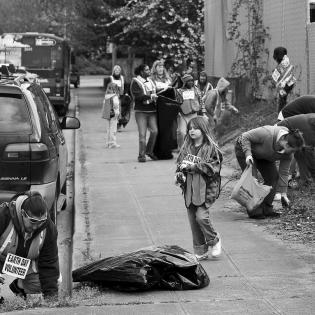
Lesson Three: Students plan and carry out a project to improve the school environment, such as separate recycling around school, rake leaves, pick up garbage, or educate others through informational posters.

Unit Assessment:

  • Assessment will be based on the students’ participation in class, their questions, comments, and performance on the worksheets and writing activities.
  • Student performance in the group project can be assessed through attitude and amount of participation.

School/Home Connection:

“Copy-and-Paste” Class/School Newsletter Information Insert:
What does traditional Jewish text tell us about stewardship, or taking care of the environment?  This is the focus of our current unit of study: This Land Is Our Land.  We start with creation and retell the story in which G-d created the world and lead to our responsibility to protect it.  Through three different lessons the students receive a solid foundation and understanding that there are simple things we can do each day to preserve the environment and not to waste the good things that we do have. The students (at this young age) will feel empowered to participate in activities that improve the of outdoors, school, and home environments.  We will stress the idea that “many hands make light work” in regards to the environment.  It is everyone’s responsibility to make small contributions to take care of the needs of the earth and its environment.  We hope the students will share their enthusiasm with their families.  We encourage you to get involved in some environmental activities as a family. 

Interactive Parent/Student Homework:
Students will be asked to collect items from home that are usually thrown away, but will be used to make craft projects (example: baby food jars, tin cans, paper towel cardboard tubes).
Students and parents can design together some responsibilities around the house children can perform in order to improve the status of the environment inside and outside of the home.

State Curriculum and Philanthropy Theme Frameworks:

See individual lessons for benchmark detail.

Lessons Developed and Piloted By:

Rachel Rothner
Areyvut
http://www.areyvut.org
147 South Washington Avenue
Bergenfield, NJ 07621

Submit a Comment

All rights reserved. Permission is granted to freely use this information for nonprofit (noncommercial), educational purposes only. Copyright must be acknowledged on all copies.

Copyright © LearningToGive.org