Exploring Our Community
The children explore attributes of the community in which they live. They compare ways to be generous in rural, urban, and suburban communities.
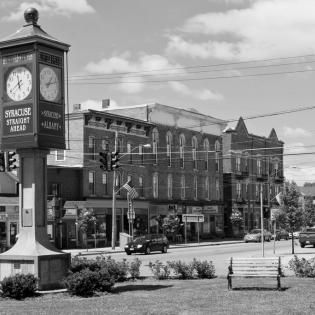
The learner will:
- identify urban, suburban and rural areas.
- City Mouse & Country Mouse: A Classic Fairy Tale by Isabelle Chantellard
- Butcher paper, markers, crayons
Children talk to their families about the type of community they live in: urban, rural or suburban. How do neighbors support one another in the type of community in which they live? Has their family (and ancestors) always lived in this type of community? If not, when and why did they move/change?
- Chantellard, Isabelle. City Mouse & Country Mouse: A Classic Fairy Tale. Abbeville Press, Inc., 1999. ISBN: 0789205130
Instructions
Anticipatory Set:
Remind the children that there are many types of communities. The words urban, suburban, and rural describe the types of areas where people live and work. Define and discuss each of these terms: urban: related to city; suburban: related to a residential area just outside a city; rural: related to the country. To give an understanding of the variations, talk about the types of jobs, buildings, space, animals, plants, and other characteristics that are of each area. Decide as a group which characteristics best describe the area where they live and what people do for each other in their community type.
Read the story: City Mouse & Country Mouse: A Classic Fairy Tale.
Discuss how the mice feel about their own communities. Discuss: “Which place is better to live? Why do the mice disagree? Why do people choose to live in different areas?” Lead the children to understand that one type of community isn’t better than another, just different. People choose where to live based on their interests, abilities, needs, and resources.
Put the children into three groups and give each group a piece of butcher paper. Assign an area to each of the groups: urban area, suburb, and rural area.
Talk about how to work cooperatively in groups, such as sharing, talking things out, taking turns, respecting each others’ ideas and getting everyone involved with decision making.
Each group works together to illustrate people helping each other in their assigned area by drawing them with buildings, plants, space, houses, roads, and animals.
When they are finished, hang the three pieces of butcher paper together to make one whole community—urban, suburban, and rural. Talk about how the three communities depend on each other and enjoy the resources of the other communities.
Philanthropy Framework
-
Strand PHIL.I Definitions of Philanthropy
-
Standard DP 02. Roles of Government, Business, and Philanthropy
-
Benchmark E.7 Describe the concept of competing self-interest.
-
-
-
Strand PHIL.II Philanthropy and Civil Society
-
Standard PCS 01. Self, citizenship, and society
-
Benchmark E.3 Describe a benefit of group cooperation.
-
-
Standard PCS 04. Philanthropy and Geography
-
Benchmark E.3 Describe the "characteristics of place" related to the school and neighborhood.
-
-
Standard PCS 05. Philanthropy and Government
-
Benchmark E.7 Describe why the classroom, school, or neighborhood is a community governed by fundamental democratic principles.
-
-