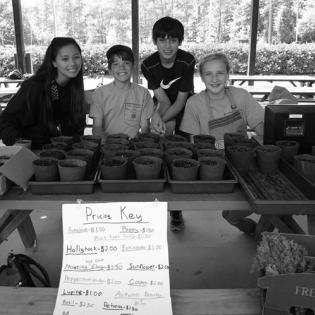
Through four lessons students will understand the concept of Environmental Stewardship. Using a children’s story about a neighborhood working together to improve the appearance of a vacant lot, student will decide how they will participate in a community project to beautify their community and becoming Stewards of the Earth.
Focus Questions: Why do we need plants? Who's responsibility is it to be an Environmental Steward of the natural world?
The learner will:
- define philanthropist/philanthropy.
- brainstorm acts of kindness/philanthropy that benefit others.
- select and begin a community project for the class to do that will make a difference in others’ lives.
- compare different ways of reading fiction and nonfiction text.
- recall facts from a nonfiction text.
- participate in a scientific experiment.
- respond to an investigation through charts and writing.
- identify and describe the interconnectedness of nature.
- recognize the importance of environmentalism and his/her role in the effort.
- design and create a poster communicating his/her feelings about trees.
- communicate through body movement the imagined feelings of trees.
- respond to text and recall details.
- create a flower with a variety of art materials.
- reflect on the community planting experience.
- write a response, detailing sequence of events and expressing feelings.
Students decide on their service learning project during the first lesson, and work on this project each day during the unit, and possibly after the unit is completed. Some suggestions that the children may choose from are: planting and taking care of trees around the school or community, building a nature center at the school, taking care of an already existing nature center, building a community garden at a local park or helping in a community garden that already exists. This project will teach children how important it is to help out in the community, what types of things they can do in their community and the difference that is made when citizens help even in a small way.
In all lessons, teacher assesses students through observation and completion of specific expectations.
"Copy-and-Paste" Class/School Newsletter Information Insert:
We are beginning a unit called "Watch Me Grow." Your child will be learning all about plants and how they grow as well as how to make a difference in their community. As a class, we will be creating a service learning project from the material learned in class. While working on this project in class, you, as families can help at home by talking with your child about what they are learning.
Your child will be learning about philanthropy--sharing time, talent and/or treasure for the common good. We will be discovering what a philanthropist does, what they give to their community and why. We will be learning about the environment, as well. Please take time to talk to your child about these different concepts.
I know you will be amazed at the amount of information your child will learn with this unit, and as families, you will be able to "watch your little ones grow" through this learning.
Interactive Parent/Student Homework:
Lesson One: Garden for Life – Encourage families to discuss actions of the heart in the community and in the home. Send home a copy of Lesson One, Attachment One: An Action of the Heart. This also includes some simple plant projects to do at home.
Teacher needs to set up a community service project with students on the first day of unit and work on it daily to complete the task. The teacher might want to bring a landscaper in to speak to the children about gardens and what they need to think about when planning a garden. More time may be needed, depending on how in-depth the teacher (and class) decides this project will be.
See individual lessons for benchmark detail.
Lessons Developed and Piloted By:
Caryn Yarnot
Mona Shores Public Schools
Ross Park Elementary
121 Randall Road
Muskegon, MI 49441
All rights reserved. Permission is granted to freely use this information for nonprofit (noncommercial), educational purposes only. Copyright must be acknowledged on all copies.