Learning to Give, Curriculum Division of The LEAGUE

The LEAGUE

Coming to Terms
Lesson 2:
printEmail this Lesson
Lesson
Handouts
Academic Standards
Philanthropy Framework

Purpose:

Learners will become experts regarding the attributes of a tropical rainforest.

Duration:

Three to Five Forty-Five Minute Class Periods

Objectives:

The learner will:

  • become familiar with a list of rainforest terms.
  • research articles on the Internet to answer questions regarding the characteristics of a tropical rainforest.
  • share the findings of their research.
  • take notes from team presentations.
  • explore some of the problems being experienced in tropical rainforests and determine what, if anything, is being done about these problems.

Materials:

  • Notebook Paper
  • One piece of large white construction paper per team of four learners
  • Poster Board, one per team of four learners
  • Research Packet
  • Rainforest Packet Cover (Attachment One)
  • Scientists (Attachment Two)
  • Research Interests??? (Attachment Three) one per team
  • Research Interests!!! (Attachment Four) four per learner
  • Collage Scoring Guide (Attachment Five)
  • On-line computer access for each learner (or downloaded rainforest information or books on rainforests)
Handout 1
RAINFOREST PACKET
Handout 2
Scientists
Handout 3
Research Interests???
Handout 4
Research Interests!!!
Handout 5
Collage Scoring Guide

Instructional Procedure(s):

Anticipatory Set:
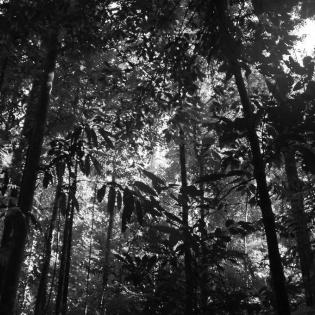
Cut out a small section of a rainforest photograph, duplicate one for each learner and hand them the sheet of paper bearing this section of rainforest photo. Ask learners to take out their notebook paper and write down what they think the whole picture might be. Have each learner share what they think the picture is.


  • Distribute a stapled packet containing all of the Attachments One-Four to each learner (Ask them that whenever they have time they are to work on designing the cover to their packet- Rainforests - Attachment One).

  • Have the learners turn to Scientists (Attachment Two) in their research packet. Using direct instruction, go over the definitions, taken from a dictionary, for each “job”. After each definition is shared, allow learners to write the definition in their own words and answer any questions they might have.  Continue this process through each the four categories of scientists.

  • Utilizing Research Interests? (Attachment Three), have each learner record why they think each of these scientists might be interested in rainforests, based on what job each scientist does. (see Attachment Two).

  • Involving the learners in a whole group discussion, have them share what they wrote on their Research Interests? (Attachment Three) worksheet. Determine some of the more common responses and then challenge the learners to answer the question:  "Is what you  think might motivate a group of scientists to be interested in rainforests in fact what is of interest to these scientists?"

  • Have the learners count off by fours and using on-line computers, have the ones’ find out what they can about anthropologists and rainforests, the  twos- botanist and the rainforest, the threes- environmentalists and the rainforest, and the fours-zoologists and the rainforest.

  • Ask the learners that they will be using the computer to find out what it is about the rainforest that might interest their assigned group of scientists. Remind them that since they will become “experts” in their scientific field they are to do their best to discover all the possibilities based on what they are able to find from their research.

  • Distribute a stapled packet containing all of the to each learner (Instruct them that whenever they have time they are to work on designing the cover to their packet).

  • Tell them to start by doing an Internet search on their topic. (Examples:  anthropologists and the rainforest, botanists and the rain forest, environmentalists and the rainforest, zoologists and the rainforest, people of the rainforest, indigenous people of the rainforest, life in the rainforest, etc.)  Some suggested sites are:
    1. http://rainforests.mongabay.com/
    2. http://www.nature.org/rainforests/
    3. http://www.rainforestfoundation.org/index.php
    4. http://edtech.kennesaw.edu/web/rforest.html
      (This last web site has links to several rainforest topics.)
  • Once all research teams have had enough time to collect their research and identify some of the common areas of interest have them record their team’s findings under the appropriate heading on Research Interests!!! (Attachment Four). (This will probably take at least one complete class period.)

  • Have the members of the research teams return to their “core” teams and share the research with their team. Each “core” team member should then record a summary/the highlights of the information shared by the ‘expert’ under the appropriate heading on Research Interests!!! (Attachment Four).

  • Have the learners turn to the Collage Scoring Guide (Attachment Five) and give each ‘core’ team a sheet of poster board. Using direct instruction go over the details of creating a collage. (You may opt to invite the art teacher to the class to review instructions on how to put together a collage or you may consult the following web site for this general  information: http://wiwi.essortment.com/howtomakecoll_rsof.htm

  • Review the Collage Scoring Guide (Attachment Five). Ask learners to read the rubric columns and answer any questions that they may have relative to it.

  • Distribute a poster board to each of the ‘core’ teams and have them divide the poster board into quadrants (four equal sections). Be sure they measure so that each section is equal.  Have them draw the divisions and work as a team to create a collage representing the value of the rainforest for each of the scientists discussed. Learners may use downloaded pictures, magazine pictures, words, phrases, drawings, etc. to complete their collage. The collage in Quadrant One should somewhere feature the word anthropologist and rainforest plus the pictures, drawings, etc that represent/symbolize the interest in the rainforest of that particular scientist. The same holds true for Quadrant Two (Biologist), Quadrant Three (Environmentalist), and Quadrant Four (Zoologist). (The collages will be used again in Lesson Three).

  • Display these collages when complete. Each collage should feature the names of the learners involved in the collage construction and a fifty-word team response to this question: What role might these scientists play in preserving the rainforests?

Assessment:

The successful completion of the Research Packet, the extent and depth of involvement in individual and group discussion and activities as well as the established rubric for the development of a collage form the basis of learner assessment for this lesson.

Lesson Developed and Piloted by:

Cheryl Larkin
Pontiac School District
Madison Middle School
Pontiac, MI 48340

Handouts:

Handout 1Print Handout 1

RAINFOREST PACKET

Handout 2Print Handout 2

Scientists

Anthropologist

Botanist

Environmentalist

Zoologist


Handout 3Print Handout 3

Research Interests???

I think an Anthropologist would be interested in studying rainforests because:


I think a Botanist would be interested in studying rainforests because:


I think an Environmentalist would be interested in studying rainforests because:


I think a Zoologist would be interested in studying rainforests because:


Handout 4Print Handout 4

Research Interests!!!

Anthropologists are interested in studying rainforests because:


Botanists are interested in studying rainforests because:


Environmentalists are interested in studying rainforests because:


Zoologists are interested in studying rainforests because:


Handout 5Print Handout 5

Collage Scoring Guide

CATEGORY

4

3

2

1

Quality of Construction

The collage shows considerable attention to construction. The items are neatly trimmed. All items are carefully and securely attached to the backing. There are no stray marks, smudges or glue stains. Nothing is hanging over the edges.

The collage shows attention to construction. The items are neatly trimmed. All items are carefully and securely attached to the backing. A few barely noticeable stray marks, smudges or glue stains are present. Nothing is hanging over the edges.

The collage shows some attention to construction. Most items are neatly trimmed. All items are securely attached to the backing. A few barely noticeable stray marks, smudges or glue stains are present. Nothing is hanging over the edges.

The collage was put together sloppily. Items appear to be just "slapped on". Pieces may be loose or hanging over the edges. Smudges, stains, rips, uneven edges, and/or stray marks are evident.

Understanding of Media

The learner can define the term "collage" and tell how it differs from two other media. S(he) can also name at least 5 things that make a collage more powerful or attractive.

The learner can define the term "collage" and tell how it differs from two other media. S(he) can also name at 3-4 things that make a collage more powerful or attractive.

The learner can define the term "collage" and tell how it differs from two other media. S(he) can also name at least 1-2 things that make a collage more powerful or attractive.

The learner has trouble defining the term "collage" and describing how it differs from other media AND/OR the learner cannot describe how to make a collage more powerful or attractive.

Creativity

Several of the graphics or objects used in the collage reflect an exceptional degree of learner creativity in their creation and/or display

One or two of the graphics or objects used in the collage reflect learner creativity in their creation and/or display.

One or two graphics or objects were made or customized by the learner, but the ideas were typical rather than creative (.e.g., apply the emboss filter to a drawing in Photoshop).

The learner did not make or customize any of the items on the collage.

Attention to Theme

The learner gives a reasonable explanation of how every item in the collage is related to the assigned theme. For most items, the relationship is clear without explanation.

The learner gives a reasonable explanation of how most items in the collage are related to the assigned theme. For many of the items, the relationship is clear without explanation.

The learner gives a fairly reasonable explanation of how most items in the collage are related to the assigned theme.

The learner's explanations are weak and illustrate difficulty understanding how to relate items to the assigned theme.

Titles and Text

Titles and text were written clearly and were easy to read from a distance. Text varied in color, size and/or style for different text elements.

Titles and text were written clearly and were easy to read close-up. Text varied in color, size and/or style for different text elements.

Titles and text were written clearly and were easy to read close-up. There was little variation in the appearance of text.

Titles and/or text are hard to read, even when the reader is close.


Philanthropy Framework:

Submit a Comment

Unit Contents:

Overview:It’s Goin' Down; The Rain Forest Summary

Lessons:

1.
What's Goin' Down?
2.
Coming to Terms
3.
The Impact
4.
Who Is Responsible?

All rights reserved. Permission is granted to freely use this information for nonprofit (noncommercial), educational purposes only. Copyright must be acknowledged on all copies.

Copyright © LearningToGive.org