6th-8th Grade
Subjects:
Language Arts, Library / Technology, Philanthropy and Social Studies
Key Words/Concepts click to view
| ELA: | Analyze/Interpret; Audience; Author's Style/Purpose; Biography; Character Development; Influence; Interview; Language/Style; Presentations; Questioning; Reflection; Writing Process |
| PHIL: | Community; Family; Giving; Motivation for Giving; Neighborhood; Philanthropic Act; Philanthropic Literature; Philanthropic Traditions; Philanthropist; Reflection; Sharing; Values |
| SOC: | Gift of All (The); Business; Civic Responsibility/Virtue; Common Good; Communities; Core Democratic Values; Environment; Family; Good Character; Natural Characteristics of Place; Personal Virtue; Point of View; Religion |
Purpose:
In this lesson, students create a gift of story modeled after the documentary The Gift of All. The students will research and/or interview a local philanthropist. Each student will write a biography telling the story of the philanthropist. They share the completed biography with an elementary student, teaching that student about philanthropy and the value of giving to the community.
Duration:
Three 50-minute lessons, plus time to research and write biographies
Objectives:
The learner will:
- define civic responsibility and civic virtue and relate to telling stories of philanthropy.
- research and write a biography of a local philanthropist.
- analyze and identify sources of beliefs and values as family, religion, personal experiences, and peers.
- publish philanthropy biographies.
- prepare questions to go with biographies.
- practice reading aloud, modeling literacy skills for elementary audience.
- go on a field trip to an elementary school to read biography.
- demonstrate and share learning to a wider community and donate books to the library.
Service Experience:
Although this lesson contains a service project example, decisions about service plans and implementation should be made by students, as age appropriate.
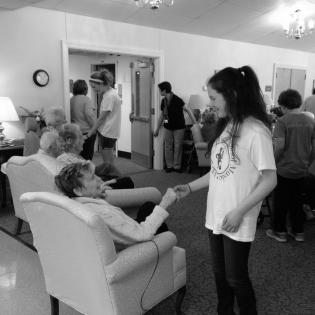
As a culmination of this unit, the students bring their completed biographies to an elementary classroom to share their stories of giving. Each middle school student will be paired with an elementary student to read their biographies and ask questions. This is an act of philanthropy as they share their time and talent with a younger student as well as teach about philanthropy, members of the community, and civic virtue.
Materials:
Completed homework of a list of community philanthropists (See Attachment One: Community Philanthropist) from Lesson Two: Exploring Our Legacy of Giving
Student copies of Attachment One: Philanthropist Research and Rubric
Student copies of Attachment Two: Interview Questions
- Handout 1
- Philanthropist Research and Rubric
- Handout 2
- Interview Questions
Teacher Preparation:
On the third day of this lesson, the students bring their completed biographies to an elementary classroom. Please arrange this field trip in advance and let the students know as soon as possible for what grade level their biographies should be geared. Each middle school student will be paired with an elementary student. The students will read their biographies and ask questions. This is an act of philanthropy as they share their time and talent with a younger student as well as teach about philanthropy, important members of the community, and civic virtue.
Instructional Procedure(s):
Day One
Anticipatory Set
Tell the students that the documentary "The Gift of All" itself is an act of philanthropy. Ask the students how these stories about philanthropists can promote the common good. Tell them that the movie was funded by philanthropists. Why would they give their money and time to tell their stories to all of us? Remind the students of Margaret Voss's statement: "We have to stand up because we saw it. We have the gift of the life we've lived that needs to be told."
- Write the words civic responsibility and civic virtue on the board. Discuss what the words mean. (Teacher note: Civic responsibility is a person’s duty or obligation to their community as a citizen. Civic virtue is morality, goodness, or uprightness that upholds community, or behaviors that promote community well-being.)
- Remind the students that the people interviewed in The Gift of All documentary talked about how they learned a sense of civic responsibility. Part of their civic responsibility is to tell their story, not because they want attention, but because they want to inspire others to give and be civically responsible. This generation has something to teach the next generations about community, giving, values, and compassion. If we don't learn from them, we have lost something. The value of civic responsibility reaches far beyond what we can see. Their legacy, or gift to future generations, has a far-reaching and lasting impact in the community.
- Now it is the students' turn to tell stories of giving. The goal of this lesson is for each student to write a story, a biography, about a local philanthropist. The story will tell about that person's connection to the community, their background, accomplishments, interesting stories, roots, family, goals, core values, significant life events, influences, career, and legacy. The stories will be shared with students at an elementary school to teach them about their community and inspire others to give. The story itself will be an act of philanthropy because it will be shared and make the community a better place as it honors civic virtue.
- Refer to the previous lesson's homework. See Attachment One: Local Philanthropist from Lesson Two: Exploring Our Legacy of Giving. Ask the students to name who they have chosen to research and write about. Keep a list of their choices. It is okay for more than one student to write about a single person. For any students who haven't made a decision, have the students offer suggestions from their homework lists. West Michigan students should select individuals other than the ones in the video.
- Give the students a rubric (see Attachment One: Philanthropist Research and Rubric) and discuss what should be included in the story and the format of the final product. Remind the students that the audience is elementary level students (give them a specific grade level if you already have set up a partnering class for this). The final product will look like a picture book with readable text, images, and appropriate comprehension level for the age.
- Give each student a copy of Attachment Two: Interview Questions. Brainstorm additional questions. Students who write about family members and other familiar people will conduct most of their research through interviews. Students who write about well-known community philanthropists may conduct most of their research through the library.
- Make arrangements for the learners to go to the library/Internet to access information and begin their research on their philanthropist. Guide the students to conduct research, set up interviews, write a rough draft, find images, revise and edit drafts, and make a final copy. This project may take several days.
Day Two
Anticipatory Set
Read aloud a picture book biography. Exhibit literacy skills as you model how to read aloud. Point out to students the format, headings, pictures, and physical features of the book. Ask questions before, during, and after reading. Check for understanding, read with expression, and use eye contact.
- Provide materials as needed to help students publish their philanthropist biographies.
- When their books are all edited and published, tell the students they need to prepare for their field trip to read to younger children.
- Have the students prepare some questions to ask the students to help them engage in the reading. Some of this may be done as a whole class, but some questions will be specific to each biography. A question or statement before reading will help focus the students. Questions during reading will check for understanding. Questions after reading are to help the younger students connect the book to the concepts of community giving.
- Remind the students that their book is an act of philanthropy in two ways: in content (learning about philanthropy and a community philanthropist) and in sharing time and literacy skills with a younger student. Make sure the students know how to read aloud with expression and to model good reading skills. Spend some time practicing reading aloud before you go.
Day Three: Field Trip
- Go on a field trip to an elementary school. Have each middle school student read aloud their book to one younger student. Before, during, and after reading, the students ask their prepared questions.
- After the field trip, reflect on the entire project. Ask the students to write in their journals about what they learned about their legacy of giving. What inspired them? What worked well in their presentation to the elementary students? What could they do differently next time? What do they plan to do next?
- Note: the books may become part of the elementary or community library. Before the books are donated to the library, have a demonstration for an audience of what the students learned and created in this unit. A demonstration may be a book donation party at the library.
Assessment:
Observe student participation in class discussions and group work. Observe students in their interactions with the elementary students. Do they model good reading strategies and engage the younger students with the concepts? Use the rubric to assess the philanthropist biographies for meeting expectations.
Cross-Curriculum Extensions:
The following lesson is an optional extension that explores Core Democratic Values and relates them to acts of community philanthropy.
Write the word "believe" in very large letters on the board. Then give an example of something you believe that is superficial (e.g., I believe that chocolate is the best flavor of ice cream). Next, give an example of a serious belief (e.g., I believe that people should be treated with respect). Then ask the students to raise their hands and offer statements of belief. Elicit both frivolous and serious responses. Create a list of student responses on the board.
- Choose one of the belief statements from the brainstormed list (one you think the majority will support) and say, "All who believe or agree with this statement, please stand." Tell the students to look around and see that this is a commonly held belief among their peers. Repeat with several belief statements.
- Write the following on the board: Source of beliefs include family (F), religion/spirituality (R), personal experience (E), and peers (P). Invite several students to come up to the board and mark one of the listed beliefs with a letter--F, R, E, or P--to indicate where the belief is learned. For example, chocolate is the best ice cream might be a belief learned from personal experience (E). Students may mark beliefs with more than one letter.
- Tell the students that beliefs are very similar to values. We learn our values from many sources. Sources include our parents, the environment in which we grow up, our faith-based institutions, peers, and other personal experiences. Another set of values are called Core Democratic Values. To give examples, ask the students to stand if they believe in the following:
- "Stand if you believe it is important to vote."
- "Stand if you believe it is important to express your opinion."
- "Stand if you believe all people are created equal."
- "Stand if you believe it is important to tell the truth."
- These commonly held values, which citizens believe are important, are called Core Democratic Values, and they have their origin in the founding documents just as our personal beliefs have their origin in family, religion, personal experience and/or peers. Ask students what they think the connection is between the Core Democratic Values and the founding documents. Be sure to emphasize that the writers were inspired by the desire to protect their values as citizens and so they expressed their ideals and expectations in the founding documents. The Bill of Rights and Constitution emphasize the importance of protecting our individual rights. The Declaration of Independence outlines the importance of government to act in accordance with values. All the documents show the value of popular sovereignty --that government must be for the people and by the people. These documents show the lasting power and need for collective action to state and preserve our values.
- To discover the subtleties of some of those commonly held beliefs, have students engage in the following activity. Move the students into eight small groups (approximately 3-4 students per group) and provide each group with a prompt question for discussion of the following Core Democratic Values: Truth, Justice, Equality, Diversity, Patriotism, Individual Rights, Common Good, and Popular Sovereignty. The following list provides a sample question for each Core Democratic Value:
- Is it okay to tell lies to protect the feelings of others?
- Should people follow rules even if they are unfair?
- Should females be allowed to play on teams that are usually all-male teams?
- Should people in the United States have the right to speak their native language, wear their native dress, and practice their traditions?
- Should people criticize our government when they feel it is necessary?
- Should children have a right to privacy regarding their lockers at school or bedrooms at home?
- Is it okay to leave lunch trash on the ground if there isn't a trash can and your arms are too full to carry it?
- If a rule or law isn't fair, whose job is it to advocate for change?
- Ask the groups to discuss and answer the question posed and then give supporting reasons for their stand. Each group should designate a recorder to write down the definition of the Core Democratic Value and the group's responses and prepare to report to the rest of the class. The report may be in the form of an explanation or a drawing that symbolizes the Core Democratic Value. Have each group give their report.
- Ask, "Which of these Core Democratic Values does your philanthropist exhibit?" Discuss individuals the students are researching and lead them to see that these values are an important influence on citizens to be philanthropically involved. After the discussion, encourage the students to include examples of these values in their biographies.
Reflection: (click to view)
Note: the books may become part of the elementary or community library. Before the books are donated to the library, have a demonstration for an audience of what the students learned and created in this unit. A demonstration may be a book donation party at the library.
Bibliographical References:
The Gift of All: a Community of Givers, produced by The S.O.U.L. of Philanthropy along with The Grand Rapids Community Foundation and Calvin College. Copyright © Grand Rapids Public Library, City of Grand Rapids, Michigan, 2008, 2009. Streaming video available at http://learningtogive.org/videos/gift_of_all.asp
Learning to Give. "SOUL of Philanthropy" project. Includes links to video, related quotations, and briefing papers (biographies) http://learningtogive.org/teachers/SOUL/
Lesson Developed By:
Betsy Flikkema
Associate Director
Learning to Give
Barbara Dillbeck
Director
Learning to Give
Handouts:
Philanthropist Research and Rubric
Philanthropist Biography Expectations
Name of Philanthropist ________________________________________ Due Date _______________
Assignment: Create a children's picture book biography about a philanthropist you interview and/or research. The stories will be shared with students at the elementary school to teach them about philanthropy and their community. The story itself will be an act of philanthropy because it will be shared and make the community a better place as it honors civic virtue and inspires others to give.
The completed biography should include the following:
- meet grade level expectations for writing and style (structure, spelling, grammar).
- content and text appropriate for the audience (readable text for elementary level, appropriate comprehension level, short sentences).
- images that enrich and explain the text (photos, drawings, symbols).
- a definition of philanthropy and examples.
- a logical storyline with details about the subject's life, values, contributions, and interesting events.
The published book format details (adjust to fit expectations):
- Cover should be made of heavy stock at least 5 1/2 inches by 8 1/2 inches.
- Create catchy title and print neatly on cover and title page with images.
- Page one is the title page, page two is blank, and page three is first page of text.
- Text should be proofread and typed.
- Include images on at least half of the pages.
Read Aloud Expectations:
- Students exhibit literacy skills as they model reading aloud and discuss their biography with a younger student.
- Ask questions to engage the reader before, during, and after reading.
- Read aloud with expression.
Interview Questions
Choose five to eight questions for research or interview. Brainstorm more or edit as a class. An interview may last 15 to 20 minutes.
-
Who in your family influenced you?
-
What are some values you learned from home, school, and faith-based instruction that led you to be a philanthropist?
-
What were your home and neighborhood like when you grew up?
-
What is your philanthropic passion (the arts, poverty, community building, etc.)? Why?
-
What was an incident that prompted your philanthropic passion?
-
In what ways has the community changed over the years?
-
Is there someone you admire for their philanthropic contribution?
-
What do you hope to be remembered for years from now?
-
How do you see young people being agents of change?